

Objective
Our objective is to find the weight of a given body using the Parallelogram Law of Vectors.
Theory
What does the Parallelogram Law of Vectors state?
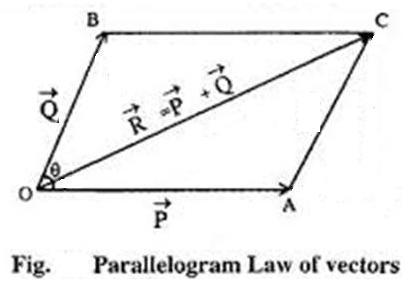
If two vectors acting simultaneously on a particle are represented in magnitude and direction by the two adjacent sides of a parallelogram drawn from a point, then their resultant is completely represented in magnitude and direction by the diagonal of that parallelogram drawn from that point.
Parallelogram Law of Vectors explained
Let two vectors P and Q act simultaneously on a particle O at an angle  . They are represented in magnitude and direction by the adjacent sides OA and OB of a parallelogram OACB drawn from a point O.Then the diagonal OC passing through O, will represent the resultant R in magnitude and direction.
On a Gravesand's apparatus, if the body of unknown weight (say S) is suspended from the middle hanger and balancing weights P and Q are suspended from othe two hangers then,

or

The unknown weight can be calculated from the equation (1).
On a Gravesand's apparatus, if the body of unknown weight (say S) is suspended from the middle hanger and balancing weights
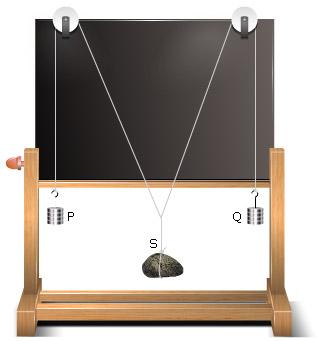
P and Q are suspended from the other two hangers then,

Now construct a parallelogram OACB by assuming a scale (say 1cm=50 gwt) corresponding to the weights P and Q. The diagonal of the parallelogram OC will give the resultant vector. The weight of the unknown body,

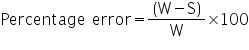
If W is the actual weight of the body, then the percentage error in the experiment can be calculated using the equation,

Learning Outcomes
- Students learn what is parallelogram law of vectors.
- They become familiar with the Gravesands apparatus.
- Students are able to find the unknown weight of an object using the parallelogram law of vectors.